
Insight qualifiedCash Conversion Intelligence · 4.2M EUR impact
Now
Action management and automation
Insight is useful.
Insight is useful.
Action creates value.
PISE converts prioritized process signals into focused work for people or governed automated responses, with the context, evidence and outcome always connected.
PISE Automation Studio Flow active
01TriggerHigh-value cash delay
→
02DecisionImpact above threshold
→
03ResponseCreate owned action
→
04OutcomeMonitor resolution
Collection action createdOwner and evidence attached automatically
+2 secFinance leader notifiedEscalation channel · High priority
+4 secEvery response is traceableSignal → Owner → Outcome
DetectDecideExecuteProve value
Beyond the dashboard
Close the distance between knowing and doing.
An insight should arrive with the affected population, business impact, recommended response and supporting evidence already attached.
PISE decides whether the next step requires human judgment, a notification, a governed workflow or a fully automated action. The response stays proportionate to risk and remains measurable from creation through resolution.
Two ways to act
Human judgment where it matters. Automation where it scales.
01 / My ActionsTask Inbox
Give people focused work, not another queue.
Each action is prioritized by business impact and arrives with the affected cases, recommendation, evidence, owner, due date and escalation context.
HighResolve delayed high-value accounts12 cases · 4.2M EUR
MediumReview payment-term exceptions28 cases · Policy control
WatchValidate recurring output failures7 cases · Evidence ready
- Impact-based prioritization
- Case and event evidence
- Ownership and due dates
- Resolution history
02 / AutomationsGoverned flows
Make repeatable responses consistent by design.
Define transparent triggers, conditions, actions, approvals and exception paths for decisions that can be executed safely and repeatedly.
WhenInvoice output fails
andValue exceeds threshold
thenNotify owner + create task
- Business-rule triggers
- Notifications and assignments
- Approval gates
- Monitoring and retry logic
Inside the product
One action layer. Two complementary experiences.
My Actions organizes human judgment and collaboration. Automation Studio designs repeatable, governed responses. Both remain connected to the same process context and evidence.
01 / Task Inbox
My Actions
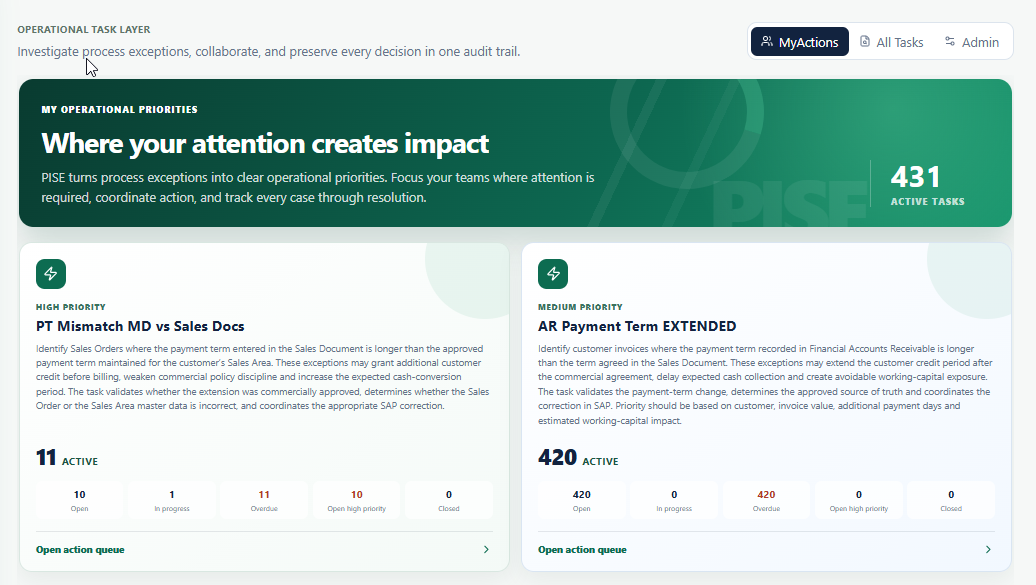
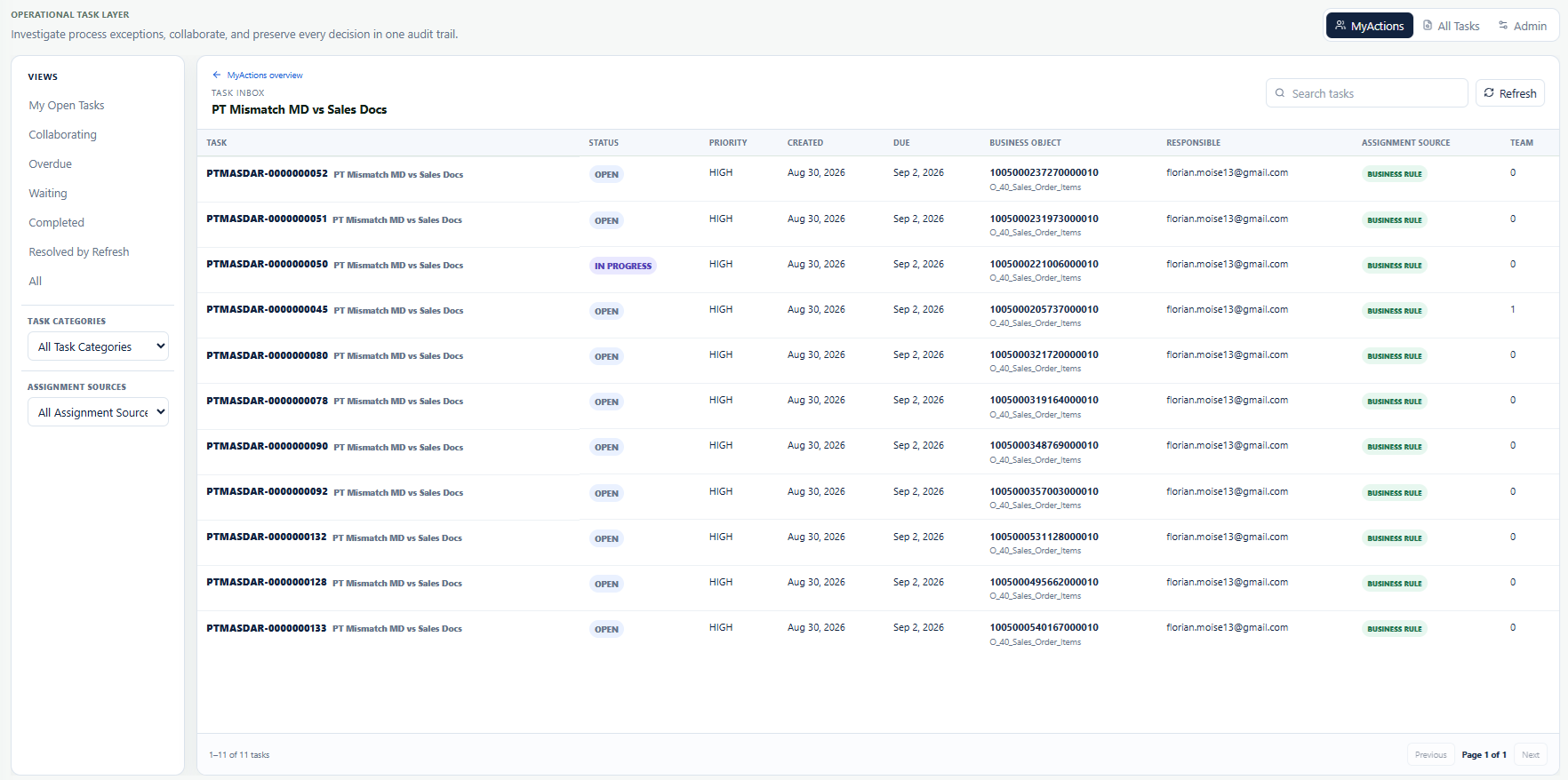
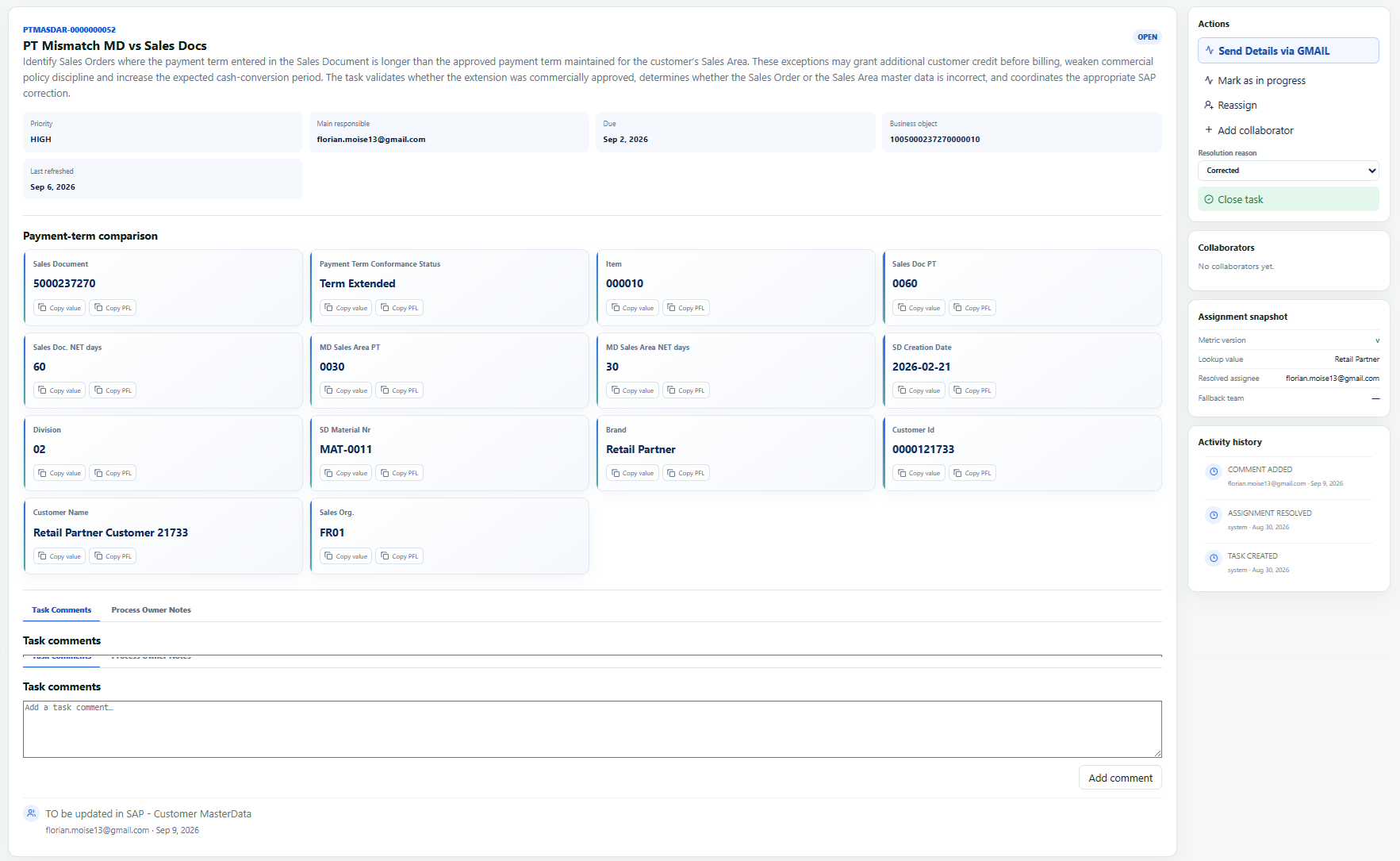
Move from an operational priority to the assigned case, its supporting details, collaboration and a traceable resolution.
My Actions overviewPriorities by impact
Task InboxOwned work
Task workspaceEvidence attached
02 / Governed flows
Automation Studio
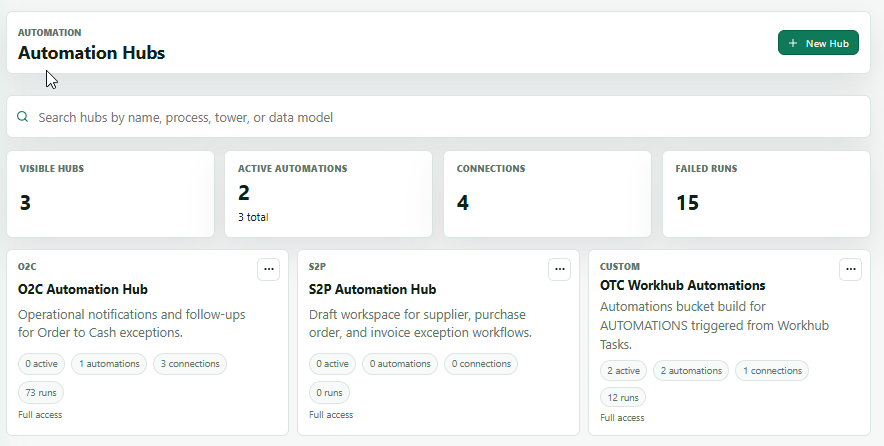
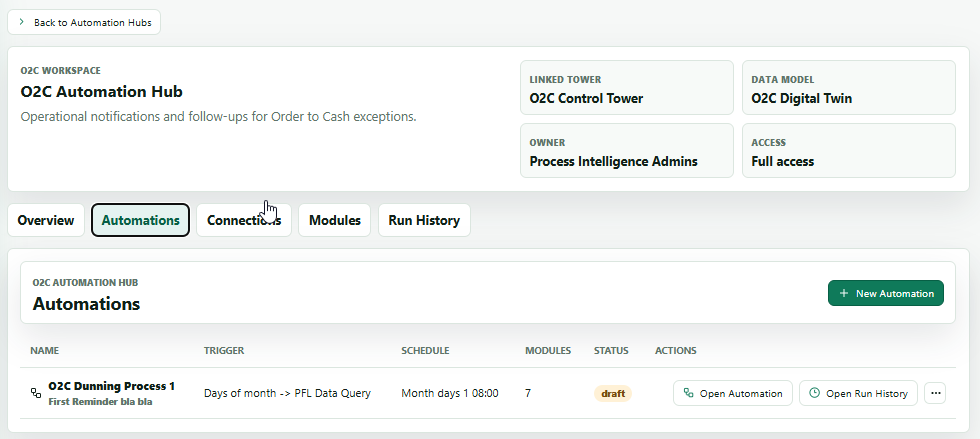
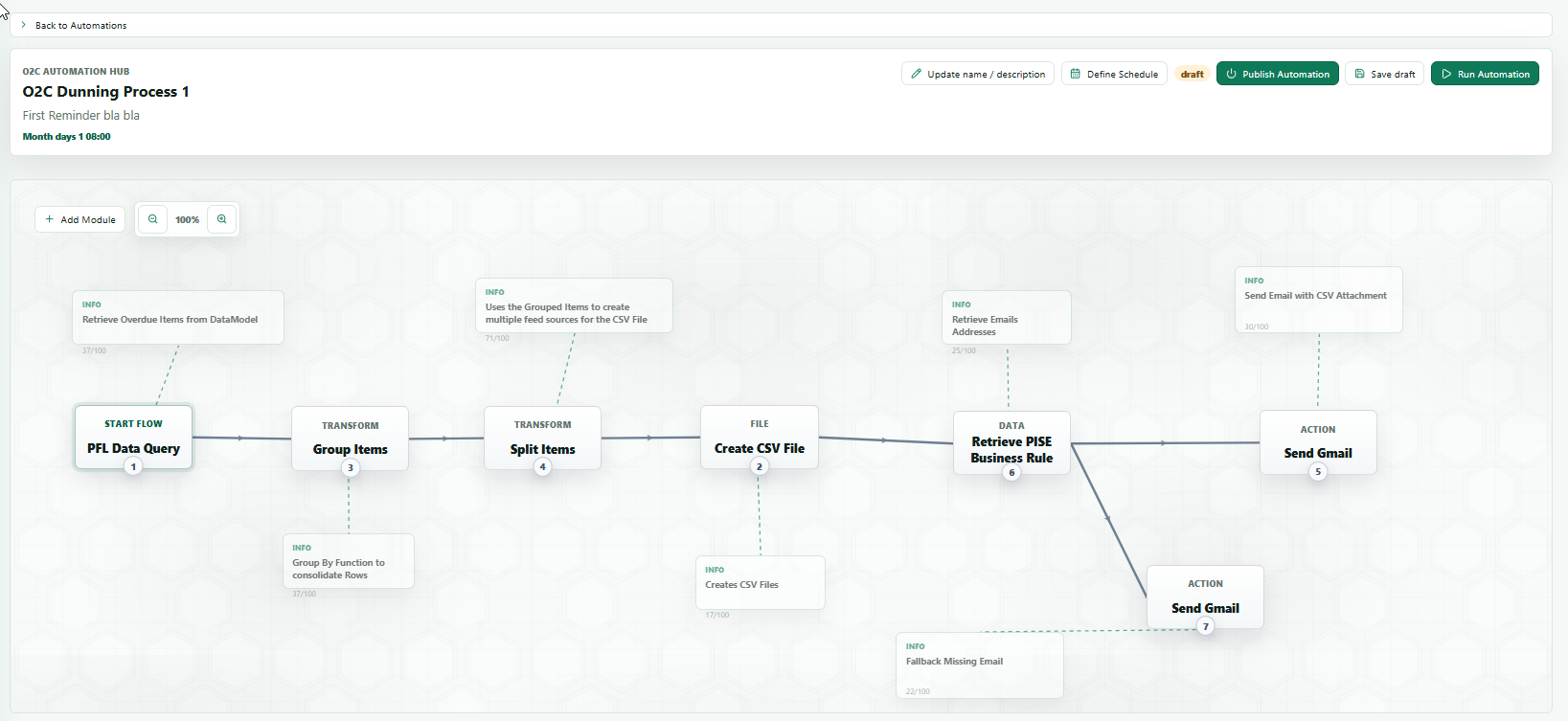
Organize automations by business process, control their schedule and lifecycle, and build the execution flow visually from governed modules.
Automation HubsProcess workspaces
Automation controlLifecycle and history
Visual flow builderFrom data to action
The execution chain
One governed path from signal to result.
The original business question and evidence remain connected at every stage, so teams can understand why an action exists and whether it changed the outcome.
Is the signal material?
Apply population, value, risk and confidence thresholds before action.
Who or what should respond?
Select an owner, team, notification channel or automation path.
What must be completed?
Guide the intervention with context, evidence and required controls.
Did the outcome improve?
Track closure, residual exposure, recurrence and realized benefit.
Core capabilities
Designed for operational ownership and control.
Business triggers
Start a response from governed KPI, event, process and object conditions.
Smart assignments
Determine ownership using company, customer, process, role and value context.
Notifications
Deliver decision-ready messages through the right channel and escalation path.
Evidence packages
Attach cases, events, documents, calculations and recommended action automatically.
Approval controls
Require human review for material, sensitive or exceptional decisions.
Outcome monitoring
Measure completion, recurrence, resolved exposure and the value of intervention.
O2C example
From cash delay to a focused collection response.
SignalA customer is forecast to pay 35 days after contractual maturity.
ImpactThe affected invoices create a material working-capital and cost-of-capital impact.
ResponsePISE creates a prioritized collection action with invoice evidence and owner already attached.
OutcomeResolution and realized timing improvement return to the management view.
Automation with accountability
Fast does not mean uncontrolled.
01Transparent logic
Users can see which signal, threshold and business rule initiated the response.
02Human-in-the-loop
Approval and exception paths keep judgment where materiality or risk requires it.
03Complete traceability
Creation, assignment, updates, evidence and closure remain in one history.
04Continuous learning
Measured outcomes refine thresholds, priorities and the next recommended action.
Turn insight into momentum