
Collect the digital traces.
Bring together transactions, event timestamps, users and business objects from ERP, CRM and workflow systems.
Process mining reconstructs how work actually happened from the digital traces left in business systems. It turns event data into a living view of the real process, including every path, delay, rework loop and deviation.
Every order, invoice, payment or approval leaves a timestamped trace. Process mining connects those traces by business case and orders them into the sequence that actually occurred.
This creates an objective process model from data, not from interviews or an ideal flowchart. Teams can compare expected execution with reality and move from an aggregate signal to the exact cases behind it.
Users, values, customers, companies and documents add the business context needed to explain why the process behaves that way.
Bring together transactions, event timestamps, users and business objects from ERP, CRM and workflow systems.
Order every event by case and time to reveal the actual path, waiting periods, handoffs and repeated work.
Compare variants, cycle times, touchless execution and conformance across the complete available population.
Prioritize root causes by impact, route cases to owners or automations, and monitor whether the result improves.
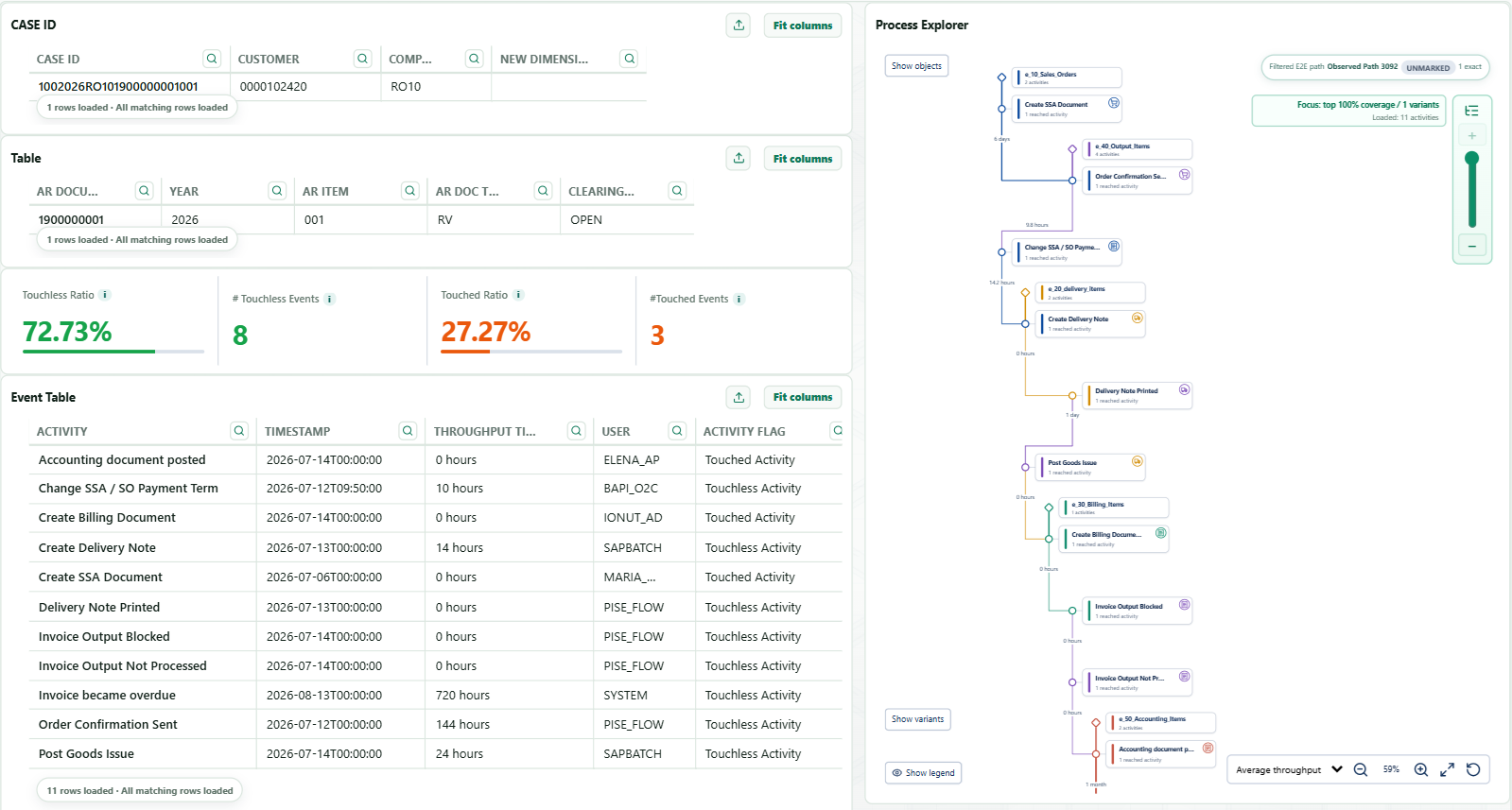
A selected case connects its source records, ordered event history and reconstructed path in one view. The insight remains explainable because the supporting evidence never disappears.
Which paths are actually followed, how often, and where do exceptional routes appear?
Where does work wait, which handoff creates delay, and how much cycle time is lost?
Which activities repeat, reverse or create avoidable manual effort across the process?
Which activities are touchless today and where can automation remove repeated intervention?
Where does execution deviate from approved sequences, policies or control requirements?
Which process behavior affects cash, cost, customer outcomes, capacity or risk?
Discover real paths, variants, waiting time, rework and deviations.
Connect behavior with customers, financial value, risk and strategic priorities.
Explain what matters, quantify the impact and identify the best intervention point.
Send work to people or automations, preserve evidence and measure the result.
No. A dashboard summarizes selected metrics. Process mining reconstructs the sequence behind those metrics and preserves the route from an aggregate pattern to each contributing case and event.
No. BI remains useful for reporting and visualization. Process mining adds sequence, time and case context, answering how a result was produced and where execution diverged.
No, but the event model must be governed. PISE makes data coverage and assumptions visible so teams understand what the reconstruction includes and where quality should improve.
Every finding can remain connected to its affected population, cases, source objects, activities, timestamps, users and calculations.